Monday, May 20, 2013

Writing Time - An Interview With Shauna Gilligan


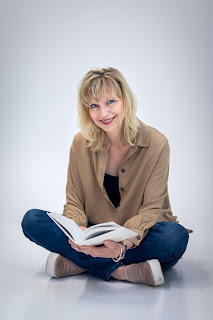
Shauna Gilligan's first novel is called Happiness Comes from Nowhere I'm delighted to chat to her about her writing time, it might spur me on a little as I've written nothing for days....oh the shame :)

Welcome to the blog Shauna, you're working on a phd as well as your own writing - so how many hours (or minutes!) do you get to dedicate to fiction in an average week, or is there an average week?!
Thanks for having me on your blog, Niamh.
Yes, I’m doing a PhD in Writing (University of South Wales) and I’ve got my Viva Voce on June 12th (that’s the oral exam where you defend your PhD thesis) so I’m nearly there with that one, thankfully!
I write every day, without exception. I try and dedicate late evening/early night to writing – that is, after my children are in bed, so usually from 9pm until whatever time I can manage. So on average it’s two to three hours a day, usually four days a week, sometimes seven. There are times when I lose track of time and it’s after midnight but other times, I’ll just do some editing and head to bed early. Bottom line is, though, if I don’t do some writing every day, I really miss it.

What is your favorite form at the moment? How do you prioritise one form over another time wise, do you have a set system allocating sections of that time for say research/poetry/stories/ your novel or does it vary?
Though I’m working on some stories right now, I have to say I tend to let the mood dictate what I do and tend not to prioritise unless there is a deadline involved.
I write long and short fiction and most of the time switch between the two, without a set system. However, when I am researching for my novels, I tend to write short fiction and often find that elements of the research creep into these pieces. I find that having a form other than that which you are trying to work on (especially when it’s tough going), frees you from that worry of stopping. Likewise, when I’m deep into a short story and find myself flailing, or needing a break, I’ll head back to the novel. When I’m engaged in academic research or writing, it’s the same process. That way I’m still engaged in the creative process. One of my writer friends who writes poetry and fiction says he can’t switch between the two like this, so I’m guessing that it is somewhat easier with mixing short and long fiction, despite the different forms. I also bake, which works wonders for finding solutions to tricky narratives or characters. I make a mean lemon cake. 

Do you find different forms almost have their season? (as I mentioned previously I like Sept for starting into a novel as the month has a ‘knuckle down’ kind of energy for me and summer can be difficult for sustained writing sessions as my children are at home so in an ideal world it would be my short story season. 
That’s an interesting question, Niamh. I have to say, so far I haven’t found a season for a form. I tend to reserve a week for pure writing (away from work, family, friends) twice a year – usually late summer/early autumn or early spring – so maybe there is something to do with a sense of finishing or starting, as you have pointed out. Carver wrote short stories sitting in his car while waiting to collect his children from school. But I think you can do those short bursts with novels as well, work on episodes or sections of the narrative but of course you also need that ‘knuckle down’ period.

 What would you say to your younger self about writing time and the different forms, what do you wish you had known years ago? 
I think I’d tell my younger self to stop worrying what it all means, and not to stop because life seems busy or somehow incompatible with the intense creativity that comes with writing. (I stopped writing regularly in my early twenties and didn’t return to it until my mid thirties).
With regards forms of writing, I’d say just write, worry about the form or what type of writer you are later. That all comes with time, but the craft takes a lot of working and reworking.
I wish I had known years ago that just because you stop writing the urge to write doesn’t go away, even if you ignore it! So you might as well just keep at it!
Thanks Shauna, that was inspiring. And best of luck with your Viva Voce!


Shauna blogs at A Girl's Writing Is Never Done . Born in Dublin, Ireland, she has worked and lived in Mexico, Spain, India and the UK. She lives in County Kildare, Ireland with her family. Her work has been published widely and she has given public readings of her fiction in Ireland and USA and has presented on writing at academic conferences in Ireland, UK, Germany and USA. Happiness Comes from Nowhere (London: Ward Wood, 2012) is her first novel.


Friday, May 17, 2013

Writing Time Rain or Shine - Interview With Nuala Ní Chonchúir


I'm fascinated as to how other writers write, especially those who write across forms, Nuala Ní Chonchúir who blogs at WomenRuleWriter has has published one novel, four collections of short fiction, three poetry collections AND she teaches creative writing part time- so I'm delighted to be able to ask her some nosey questions about how she juggles it all!

Welcome to the blog Nuala, can you tell me how many writing hours you have on an average week, or is there an average week?

I have 3 and a half to four hours a day (mornings, while the kids are at college, school and creche). So that's 18 to 20 hours a week. I can also get to my desk in the afternoons sometimes but I usually just do admin stuff then (emails, subs, a little research etc.) I do the bulk of my research reading at night in bed and take notes then. That reading is for the next day's writing. I am not reading much for pleasure at the mo as I am writing a historical novel and it requires a lot of research.


You write novels, short stories and poems, how do you prioritise one form over another time wise, do you have a set system allocating sections of that time for poetry, your novel, stories or does it vary?

I try to be good and use my mornings for 'real' work (at the moment my novel). I go to the novel first and write as much as I can, hoping to reach 500 words minimum but, more often than not, I don't reach that. If I am working on a story, I get to that next (mostly short-shorts these days because the novel doesn't allow the head space for anything longer). I usually have an essay, article or review to work on too, and that is third in line after the creative work. Poems only come occasionally and I don't worry too much about them.

Do you find different forms almost have their season? I like Sept for starting into a novel as the month has a ‘knuckle down’ kind of energy for me and summer can be difficult for sustained writing sessions as my children are at home so in an ideal world  it would be my short story season.
I'm the same - I like to start something big in September. I think it's because I always loved school and college and I love that feeling of starting something fresh. The novel in hand has proved so up-and-downish that I swear I am going back to stories in September (or when I have finished this current novel).
Also, the kids being around during school holidays is distracting. No matter how much I warn them that I don't want interruptions, invariably one of them comes in needing a lift or saying they are 'starving'. It's no wonder Edna O'Brien sent her boys off to boarding school!

I know, mine are always 'starving' - you wouldn't know it to look at them though! What would you say to your younger self about writing time Nuala, is there anything you wish you had known say ten years ago?
I have always been very organised with my writing time. I had my first kid at 23, so as long as I have been serious about writing, I have been a mother and in demand, so I just had to be organised. What I'd say to others is: Get organised! Books are written one word at a time and if you do not gift yourself the time to write, you won't write a book. Turn off the TV. Get up early. Do whatever it is you have to do to carve out writing time. Anyone I know who is seriously compelled to write, does not use the time excuse. They make the time regardless of what other people want/say/do. Prioritise!

Thanks to Nuala for coming over, and if there are any other writers out there who'd like to be interviews on how they juggle time let me know :)  And have a good weekend!

Monday, May 13, 2013

Ballymaloe Poetry Prize & other things


The Moth Magazine

Ballymaloe International Poetry Prize is organised by  The Moth Magazine and will be accepting entries from June 1st. The cash prizes are 10,000 euro, 2,000 euro and 1,000 euro. yes, that's right. 10,000 euro. Can you imagine? The details are here The summer issue of The Moth will be out soon. I'm delighted to have a poem called 'Petronella' included in this edition. As you can see from the image, its always a stunning production.  And if you are ever stuck for inspiration, I can recommend Magpie Tales for interesting weekly writing prompts.

I'm always interested in how other writers organise their writing time, so if anyone would like to feature in guest post or blog interview on that subject let me know in the comment section. I'm especially interested in 'multi form' writers, it can be challenging enough to prioritise writing in every day life, but how within that do you prioritise your novel, short stories and poetry? Which comes first?

At the moment, my novel comes first but when I hit a certain amount of words I treat myself to some time working on my current short story. I write poetry in a more random and sporadic way (ie when I should be doing other things!) Blogging (as you might have noticed!) comes last, at maybe one post a week. I would love to talk to other writers about how they portion out their brains, and how long they go before they start to feel dizzy :)

Wednesday, May 8, 2013

First Drafts


The scariest moment is always just before you start.
Stephen King- On Writing

How do you go about writing a first draft? Everyone has a slightly different approach, every book requires its own pace and techniques, this is my way... (for the moment !)

The Words
Writing a novel can seem like a huge undertaking, but like anything else if  its broken down, made bite sized; its much more doable, and not so scary. That's why I count words. It doesn't sound like the most romantic/inspired way to write, but inspiration has little to do with a book getting finished. I count the daily word count and set short term goals and deadlines for myself. And post these on the fridge in bossy handwriting :)

Everyone has a different approach to a first draft, some write an outline, you can do this by writing a couple of pages summarising your novel, or making a list of scenes you need to write, or drawing a graph. It's like having a map. I prefer to work blindly and feel my way through the first draft. I'm not sure if this is the best way, it doesn't suit everyone, I'm not even sure it suits me :) 

Whether you  use an outline or not, you need to count words, you need to decide how many words a day you want to achieve and how many hours a week you can get to the laptop/notebook. Even if you only write 500 words a day, 5 days a week, you'll have a novel written by this time next year. A log book is helpful, a small notebook where you write the date and your word count, its also encouraging to see the numbers rise.

 The Talismans
Though I don't outline, I do collect images and pin them onto my notice board. For my last novel I had a box filled with old newspapers from the period I was writing about, for this new novel I keep paint brushes in a small jug  by my keyboard, and photos of an artist's studio on my noticeboard. These objects become totemic, they represent the world of my novel and help me make the shift from the real world to that world when I sit down to write. A poem or quote can help you along the way, I like this one by William Stafford.

The Way It Is
There’s a thread you follow. It goes among
things that change.  But it doesn’t change.
People wonder about what you are pursuing.
You have to explain about the thread.
But it is hard for others to see.
While you hold it you can’t get lost.
Tragedies happen; people get hurt
or die; and you suffer and get old.
Nothing you do can stop time’s unfolding.
You don’t ever let go of the thread.

The Heebie Jeebies
There might come a time, maybe half way through, maybe before that, where you'll have a crisis of confidence, just keep counting those words, keep moving. Don't judge your novel at this stage, leave that till later, just get the words done. And when they are done, celebrate and take a well deserved, but not too long, break. 


“Once I start work on a project, I don’t stop and I don’t slow down unless I absolutely have to. If I don’t write every day, the characters begin to stale off in my mind – they begin to seem like characters instead of real people. The tale’s narrative cutting edge starts to rust and I begin to lose my hold on the story’s plot and pace. Worst of all, the excitement of spinning something new begins to fade. The work starts to feel like work, and for most writers that is the smooch of death.”
Stephen King- On Writing 

Wednesday, May 1, 2013

The Box Arrives

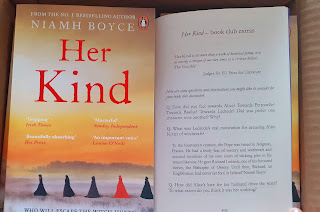
My 20 authors copies arrived at noon!


I'm not letting it out of my sight.


 The novel isn't released till June 6th
so I won't say anymore about it, honest!

Monday, April 29, 2013

Thanks For Nothing Hippies


Sarah Clancy is a wonderful poet and I'm delighted to get this chance to talk to her about her latest collection, Thanks For Nothing Hippies.

The first thing that struck me about your work Sarah was its freshness and energy, do you write your poems immediately they come to you? Or do you write them later on reflection?  
Thanks!! I write them whenever and wherever. Normally, not always now but usually, I sit down and decide I am going to write and then I see what comes of it rather than having an idea before I’ve sat down. I’d often have a feeling and a place or context but not an idea. I don’t really do any of the writer-ly things like carrying a notebook and scribbling lines in it.  The writing is probably immediate for that reason- I let the poems go where they want and fix them as I go and when I’m finished. I have no shortage of ideas and so I don’t hunt down poems, I may do yet but it’s hard to think of writing like that, like someone in pursuit of an idea. I love writing poems and so it’s not a chore for me. I wouldn’t recommend my method though as I am still learning learning learning how to do it and why to do it and may change my mind completely.

Your work seems so woven with (what I imagine) is your life is poetry for you a daily practise?
Yes if I feel like writing I could write a good few poems in a day, it’s not separate so for example if I sat down to do a bit of work I might scribble down some poem first then do whatever it was I was doing. Sometimes I also like to just play around and that would be when and where I end up with poems that are for the most part little ‘fictions’ that is I pretend I am someone else or that I know how someone else feels to write them. I like those much more than anything introspective. I delete loads and loads of poems and in order to do that I have to write a heap of them first. I kill the weakest or the annoying ones and maybe play around with the ones I like a bit and then I either keep those ones,or else I give up on them and write more.

I love the idea of poems from and about everything and I have a whole lot of unusual or rushed, packed- in life experience gathered that I don’t know what to do with and haven’t finished with myself so I could maybe talk about it in a bar to strangers or bore someone with photos about it or I can write poems from it instead and disperse it that way from me, leaving the way clear for more adventures to be gathered. Not sure if that makes sense but I think it’s someway accurate.  

Do you believe in the sacredness of the first draft or do you make many changes from first draft to last?
I have discovered that for the most part I edit as I write. (I write on a laptop) so I will be fixing line lengths, rhythms, sound as well as trying to get at the meaning I am after as I write the poem. I often tweak the poems and then, if I am not too  impatient I’ll say them out loud to myself and if I trip or find any bit awkward I’ll remove or replace it and if I can’t I’ll delete it. I do keep tweaking them though and I have published plenty that I probably could have tweaked a bit more. Life is the thing for me I want a poem to have life, it doesn’t matter if it is spare and serious in topic or if it’s some light-hearted mischief, for me I want it to have life and that’s what I edit for usually. So I think yes I change poems many times from first to last draft but I do it lightly and ‘bravely’ and don’t worry too much if I wreck them.

Are public readings part of that process, Sharon Olds mentions this as being true for her? Would you ever revise on the basis of how the poems reads or is received?
 Yes! Any poems that I have published without giving them a few trial runs in public first have stuff wrong with them (how’s that for artistic? Stuff!) I am a very impatient writer and so things get out there in the world before they should sometimes, I’m not sure it matters because often they can be the ones that other people enjoy most however I find that they aren’t easy for me to read or perform which would tell me that something is awry in the scheme of the poem. I lose more though, by overworking a poem than underworking one.
Performance wise, I often edit poems after the first few times I read them, live audiences are great for pointing out any places in a poem where you went on unnecessarily long or indulged yourself with phrases and lines that weren’t needed. They tell you this by yawning, by checking their phones or whispering to their companions and shifting around in the seats.
So that’s the editing bit, the public bit I also in some way agree with I have very few poems that are not public, now I don’t mean that they address the public on big issues necessarily but for me the act of writing a poem is in a way of asking myself what would this (this issue, this emotion, this doubt, this question, this fear, this love etc etc) look like if I made it public, how would it be then? And that’s what I write for; a kind of kamikaze making public of private things, often invented private things from the invented minds of invented people but still you’ll know what I mean.

Can you tell me about the title Thanks For Nothing Hippies?
 I stole it, it was a slogan from somewhere that I saw that later became graffiti in Galway (which I had nothing to do with honest). A couple of years before I began writing poetry I was doing an MA in NUIG and I had wanted to call my thesis, (which was on whether or not non- violent resistance or peaceful protest could be effective in a globalised neo-liberal world) ‘Thanks for Nothing,Hippies’ but I chickened out that time. It is tongue in cheek and slightly cynical but more or less is an observation much as was made by Henry Thoreau in Walden that ‘dropping out’ on its own by an individual doesn’t change what’s wrong or unjust, that actually takes work and action. This is getting more serious than my choice of title was but those are some of the ideas and themes behind it. 

Thanks for dropping by Sarah, and just one last question - do you have a favorite quote, a favorite poet?
I don't know about 'favourite' poet I like lots and lots but at the moment an odd little mix of Frank O'Hara, Adrienne Rich, Pasolini the Italian film-maker/poet and I am enjoying Charles Simic's work at the moment. 
Same for quotes I have lots I use for work etc possibly my favourite is 'Wecome to the Weekend, brought to you by the international labour movement''. Or Alice Walker's ''the most common way people give up their own power is by thinking they don't have any'' and similarly from Howard Zinn ''If we remember those times and places—and there are so many—where people have behaved magnificently, this gives us the energy to act, and at least the possibility of sending this spinning top of a world in a different direction.''

You can buy Sarah's book & read some more of her poems here at  Salmon's website 


Horse Thief
by Sarah Clancy

I come from a long line of robber barons
with a great welcome for myself,
I'll eat your food, drink your wine
then I'll set your crops alight
and vanish to the mountains with
your horse and cattle charmed and
walking so light-footed behind me
that you wont have heard a thing,
then I'll take the torch you're carrying
and hurl it backwards so at dawn
all you wake to are empty fields with
nothing left but the charred and bitter embers
of a half remembered plundered past.


Thanks For Nothing Hippies published by Salmon Poetry....
 

'This book may be the essential survival guide to nearly everything for the disaffected; it offers its off-kilter judgements on issues as wide ranging as Mexico’s narco wars or surviving in a modern workplace, it endures scarcely tolerable bus journeys in odd places and provides a myriad of tips for ruining perfectly good relationships along the way. In these restless and darkly funny poems the writer trawls life’s horrors, pleasures and its most banal irritations in search of an identity she can live with. Irreverent and imaginative this collection could be described as a poetry whodunnit where the writer has no illusions that whatever ‘it’ was she did it herself.'


Sarah Clancy has been shortlisted for several poetry prizes including the Listowel Collection of Poetry Competition and the Patrick Kavanagh Award. Her first book of poetry, Stacey and the Mechanical Bull, was published by Lapwing Press Belfast in December 2010 and a further selection of her work was published in June 2011 by Doire Press. 

Her poems have been published in Revival Poetry Journal, The Stony Thursday Book, The Poetry Bus, Irish Left Review and in translation in Cuadrivio Magazine (Mexico). She was the runner up in the North Beach Nights Grand Slam Series 2010 and was the winner of the Cúirt International Festival of Literature Grand Slam 2011. She has read her work widely at events such as Cúirt and as a featured reader at the Over the Edge reading series in Galway, the Temple House Festival, Testify, Electric Picnic, O Bheal and at the Irish Writers’ Centre, she was an invited guest at the 2011 Vilenica Festival of Literature in Slovenia and in Spring 2012 her poem "I Crept Out" received second prize in the Ballymaloe International Poetry Competition.


Saturday, April 13, 2013

Flash Flood


FlashFlood is an international flash-fiction journal edited by a team of volunteer editors on behalf of National Flash Fiction Day so wherever you are in the galaxy,  they want your best flash-fictions!

The word limit is 500 words. Any subject, any genre, any style, any perspective, anything as long as it's flash. Submissions close at the 23.59, Wednesday 17th April 2013 (BST), so don't delay.
The stories will be posted regularly throughout the day on Friday 19th April, providing you with a constant diet of brand new flash-fictions to fill your day. So- paste your story into the body of your email and send it to flashfloodjournal@gmail.com. (A maximum of 3 pieces per author.)

For more info go to - FlashFlood

Friday, April 12, 2013

Mslexia Poetry Prize


Mslexia Magazine have a competition for unpublished poems of any length, in any style, by women poets. The judge is Kathleen Jamie, & the closing date is the 17th June... ages away! The entry fee is £7 for up to 3 poems which isn't too steep either. For more information- click HERE - have fun :)

'I'll be looking for a poem that has energy (which is not the same as noise). I'll be seeking a poem which shows the tug and pull of language, written by a poet who has listened to what the poem wants to be.' (Kathleen Jamie)

Wednesday, April 3, 2013

Elbows Out!

 
This is an extract from an interview with writer Julianna Baggott, novelist, essayist and poet, where she was asked to give advice to mother/writers. 

'Put your elbows out, protect your time. This means that if you have a partner, that partner must step up and -- this is the tricky part -- you must allow them to step up and find their own way to parent. This is an act of deep trust. It means that you can't micromanage from the computer chair. It means that the sippy cup tops and bottoms might not match. We talk about sexism in the publishing industry and there's much work to be done, but most of that work begins with two people having a conversation at a kitchen table late at night after the baby has finally fallen asleep, two people who have to decide -- often with limited resources -- which career deserves to be pushed, deserves time and support. Writers often fail at this conversation. Women writers often cave at this moment -- do their budding careers truly deserve time?  Assert yourself now. Set the ground rules early. Elbows fucking out. You deserve the time. Your partner needs to step up. This is where it begins.'

She also has some interesting thoughts on learning to 'write while not writing'. She tells the story to herself, visualizes, perhaps while driving, cooking etc ... &  she has also learned to head edit... she calls it "Efficient Creativity..." I would highly recommend the full article  HERE  

How do you manage to juggle motherhood and writing? Funny how the juggling of fatherhood and writing rarely appears to be an issue, or is that changing ? :)

ps Thanks to Doireann Ni Ghriofa for tweeting this article btw!


Friday, March 29, 2013

Poetry Bus 5

 
Illustration by Steve Simpson


Ever (like me!) get tired, worn out or despondent while waiting weeks, that turn into months for an acceptance or rejection? Well here's some good news and an editor who cares... Peadar O' Donoghue  of The Poetry Bus Magazine has this to say....

'PB mag.
Accepts simultaneous submissions (be sure to tell us though)
Accepts emailed submissions
Acknowledges your submission right away
Replies with a yes or no with a personal email
Replies within one calendar month Maximum
... Often replies within a week'


To submitt to the Autumn 2013 issue of PB email 4 or 5 poems (max)to thepoetrybusmag@gmail.com
Offers of artwork/illustrations are also welcome.


So good luck, and happy Easter :)

Wednesday, March 27, 2013

Crannog 33


Crannóg is one of Ireland's leading and longest running literary magazines; the closing date for Crannóg 33, the summer issue, is March 31st.  They accept submissions of poetry (no more than three poems under 50 lines) or prose (one story of under 2000 words). Submissions by email only, for more details click here

Monday, March 25, 2013

Fish Poetry Prize


There are a few days left in which to enter your poems (max 300 words), the competition closes on the 31st of March, and the results will be announced on 15th May. This years judge is Paul Durcan.

Friday, March 22, 2013

Coming in June

It's getting close to publication date ( June 6th), which is both exciting & terrifying. I'm trying to immerse myself in this new book I'm writing to keep from having daily panic attacks - its deadline is my lifeline :)

Saturday, March 2, 2013

retreating...

photo by Sarah Clancy


photo by Sarah Clancy
If its been quiet here for a while, its due to the fact that I've been temporarily living a life miles away from my own. I've been hanging out at the edge of the world, listening to the sea, meeting other writers, quaffing wine, laughing, running, keeping the stove burning, day dreaming, night dreaming and scribbling. I was on a retreat at Cill Rialaig - a restored pre-famine village on Bolus Head at the very end of the Iveragh Peninsula.

Once away from the routine and chores of daily life, work, motherhood etc... I imagined that I'd be writing every second of every day, even through the night, would I even have time to eat? In truth, it took a few days of wrestling with stories that needed endings, poems that needed clear eyes before I could begin to write anything new. And no, I didn't write every minute of every day - I couldn't live somewhere so beautiful and atmospheric and keep my head down. That wouldn't be living. More and more, I'm finding that I need to strike a balance, and surprisingly that means writing less and living more, in order to have a better quality life as a writer. So I wrote early and wrote late, and in between I ran, prepared meals, and met with the other residents who were full of fun, warmth & stories of their own.

The suspicion that my house was slightly haunted has provided fuel for the novel I'm working on at the moment, as has the brutal, beautiful scenery of Cill Rialig itself. I ended the week by travelling to Cork and reading as guest poet at ó' Bheal session, brainchild of the charming and talented Paul Casey.

And, for anyone with a story or poem that needs a home...
The Cúirt New Writing Prize is still (just about) open:
The poetry entries must consist of 3 poems under 50 lines each, and the fiction pieces may be up to 2000 words. Entries in both English and Irish are welcome.Three copies of the work are required and a €10 entry fee applies, which must be a postal order or bank draft. Writers submitting work should not have had a collection published in the category in which they enter.This does not include the publication of single poems, stories or chapbooks. Send to - The Galway Arts Centre,47 Dominick Street.

Monday, February 11, 2013

Inspiration is for amateurs


Needing this advice right now! I'm in the early days of writing my third novel, and wishing I felt a little more inspired and excited, Nuala Ni Chonchuir says more about what she calls The Novel Fear here
 
“The advice I like to give young artists, or really anybody who'll listen to me, is not to wait around for inspiration. Inspiration is for amateurs; the rest of us just show up and get to work. If you wait around for the clouds to part and a bolt of lightning to strike you in the brain, you are not going to make an awful lot of work. All the best ideas come out of the process; they come out of the... work itself. Things occur to you. If you're sitting around trying to dream up a great art idea, you can sit there a long time before anything happens. But if you just get to work, something will occur to you and something else will occur to you and something else that you reject will push you in another direction. Inspiration is absolutely unnecessary and somehow deceptive. You feel like you need this great idea before you can get down to work, and I find that's almost never the case.”
- Chuck Close