Helena
Duggan is a writer from Kilkenny, a medieval, haunted city in the south of Ireland. A Place Called Perfect is her first
book. I met Helena many years ago on a writing course. Our group got on so well, that we still meet regularly and hound each other to keep writing:)
Hi Helena! What inspired
you to write A Place Called Perfect?
the original glasses!
I always wanted a pair
of round rimmed glasses. Most people think when I tell them that I must’ve
loved John Lennon or Harry Potter, and while Harry Potter is definitely on my
list of favorite people - neither is the reason for my love of round specs. It
was actually James Joyce who sparked my interest. I’d love to say I'd admired
Joyce’s work from an early age, but truth be told, I didn’t know who he was
outside of the fact that he was a man in a painting my mother owned and he wore
the coolest glasses. Years later I saw a similar pair in an antique shop in
Australia and I bought them convinced I would change the lenses and wear them
myself. That never happened. The more I carried the glasses the more I began to
think about their last owner. I wondered if he or she were dead and surmised
they were as I the glasses were antique. I began to think about that person and
their life. Maybe their memories had become locked inside the lenses and if I
got rid of them - I’d be throwing away the last pieces of that person. This
idea set me on the path to Perfect.
Perfect is a fascinating place, is it
based on anywhere in particular? What was it like creating a world?
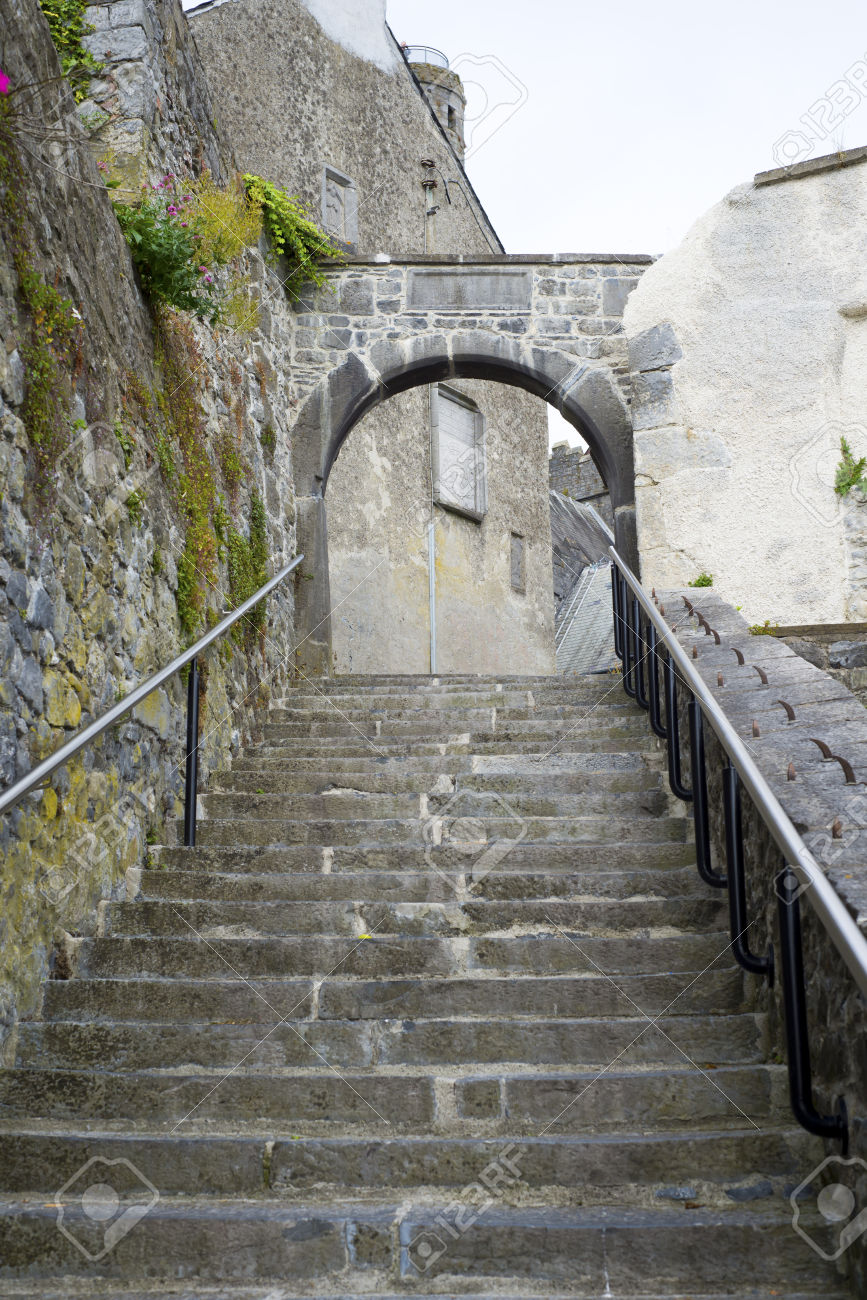
It’s based on Kilkenny.
I hadn’t started out basing it here, it just kind of happened organically. I
needed a family name and I chose Archer. It’s prominent in Kilkenny’s history,
and it lent itself to both good and evil characters. Then I needed a place
where part of the town could be hidden inside the other part without anyone
noticing. Kilkenny’s High street sits above Kieran’s Street and its stone
walls. I began to play with the idea of extending few walls here and there and
locking Kieran Street inside the rest of the Town. This worked well as did the
underground passages, cobbled roads and medieval graveyards of Kilkenny and
slowly Perfect began to take shape. It was never a concise decision just
something that happened really and I wasn’t aware that I was creating a world
until it was created, otherwise I’m not sure I’d be able to do it ;)
And, last question Helena! Who is your favorite writer?
I love Roald Dahl, I
read his books loads when I was younger and loved his language and how he made
up his own words. Most of what I remember while reading his books is laughter.
I think I laughed a lot and that feeling has stuck with me. I also really love
JK Rowling's Harry Potter books. I haven’t read any of her other works. I think
Harry Potter has stuck with me because she created a totally believable story
right from the beginning, none of the seven books feel contrived and the whole
idea which was huge has very few plot holes. Her world feels real to me!
About A Place Called Perfect…Who wants to
live in a town where everyone has to wear glasses to stop them going blind? And
who wants to be neat and tidy and perfectly behaved all the time?
But Violet quickly discovers there's something weird going on –
she keeps hearing noises in the night, her mum is acting strange and her dad
has disappeared.
When she meets Boy she realizes that her dad is not the only
person to have been stolen away...and that the mysterious Watchers are guarding
a perfectly creepy secret!
You
can buy your copy HERE at Amazon - or all good bookshops
Some news! I will be launching John MacKenna's new poetry collection By the Light of Four Moons published by the ever exciting Doire Press. So come along to Carlow Town Library, this Sat night,
March 21st, at 7.30 pm. Everyone is very welcome - there will be readings from the book and refreshments.
Winner of the Hennessy Literary Award, the Irish Times Fiction Award and the Cecil Day-Lewis Award, John is a brilliant novelist, playwright, short story writer and poet, and this collection is really something to look forward to.
I'm delighted to welcome Irish writer Louise Phillips to the blog today to chat about her recently published novel Red Ribbons.
Red Ribbons is a real page turner - any tips for writers on creating and maintaining tension in their
novel?
Straight up, I’m not completely sure how you create pacing
and tension, other than go with your gut, and try your best to feel the flow of
the novel. If lots of things need to happen at the one time, and the stacks are
high at particular key points, well, the same way as you inhabit the characters
you create, get into the tension, feel the pressure, or indeed the ease,within
the narrative, if that makes any sense. In RED RIBBONS, one fast chapter was
quite often following by a much slower paced chapter as the narrative voice
alternated. This sometimes required either ending a particular text on
something reflective after a lot of action, or a heightened tense text, if the
requirement was reversed. But getting back to my first point, I think if you
really get into it, realising when elements are strained, when certain components
dictate slow or fast movement, your instinct as a writer won’t lead you astray.
The Discerning Dolls Book Club are riveted.
Did you know the
ending when you began the book?
I had absolutely no idea of the ending until about 40%
through the script. I think this was a very good thing for me, because part of
the excitement, was wanting to find out what happens next. And even when I
decided on the ending, yes, you guessed it, I changed my mind again!!
On a practical level
Louise, how many hours a day did you spend writing the novel at the different
stages ie first draft, and then later final drafts?
Time spent on first draft, was about 6 hours per day,
grabbed in early mornings, midday between work, and late evenings for 14 weeks
- nonstop. Doing the maths, 14 weeks x7 days x6 hours = 588 hoursJ. I had a deadline
mentally, so when I got nearer to it,
the writing day was even longer, so you could definitely add another 100
hours in no problem. The editing or rewriting, took another 3-4 months at a
similar intensity, and then the final copy editing stage, was about another
month. Probably 9 months of long days, especially if you have to juggle other
commitments.
Is sustaining that level of
work difficult?
Sustaining the work was difficult, it always is, but for me,
I was helped by my decision not to get distracted by dragging the writing out
for too long at first draft stage, by setting high word targets per day, and
avoiding the self- doubting voice
creeping in by concentrating on getting
the job done.
Any tips for other writers struggling to finish their novel
finished?
Tips for finishing a novel – firstly, sit down and write it (stop talking about writing it), secondly,
don’t expect it to be perfect first time, and finally, aim for a beginning,
middle, and end – sounds simple, but it takes hard work and commitment. But if
you achieve it, you’ve achieved more than most, and that ain’t bad!
What was the most difficult stage of the process for you, what was
the most enjoyable?
The most difficult stage of the writing process was getting
to the point where someone decided they wanted to publish the manuscript. The
most enjoyable, was getting to the point where someone decided they wanted to
publish the manuscript. I’m not trying to be funny about it. All stages have
their own share of difficulty, but also of great enjoyment too. Each presents
their own challenges. The hardest thing really, is making key decisions, decisions
that if you were to share with others, they might disagree with, and as the
writer, you’re never completely sure you are making the right decision – a bit
like life I guess, sometimes you have to take a chance.
Are you a disciplined
writer? - do you create rules for yourself? What are they?
I am disciplined. I don’t profess this as the right or the only
way to write, but having a routine and being prepared to work hard didn’t do me
any harm.
The rules I apply are usually based around word count. In
one way this applies a lot of pressure, but in another way, it tells you, as
the writer, that you’re free to get words down on the page. You have nothing
without a beginning – and the beginning doesn’t have to be perfect, it simply
has to be done. When it exists, perhaps if you’re lucky, you can create a
little magic.
You certainly did that! How do your family
feel about your writing success?
My family is my life. Without them, none of this would count
nearly as much. I keep wanting to use the word ‘amazing’, because it seems like
the only word that really fits. They are really proud of me, as I am of them,
and one very special moment, was signing RED RIBBONS for our first grandchild,
Catriona.
Louise signing Red Ribbons for her first grandchild Catriona
Okay, here's a horrible question for you! Define the 'perfect'
novel, what are its ingredients - does any contemporary or classic novel come
close?
The perfect novel is any novel which creates the real in the
fictional over a sustained period. I write, I read, I love books, and anyone
who loves books, knows what a perfect novel is – it’s a story which takes you into
that imaginary world and holds you there emotionally, so you to feel part of it
, and maintains your interest right until the end.
Lots of novels come very close, and I have my favourite book
shelf like many others, but Wuthering Heights, a novel I fell in love with as a
teenager, is fairly high up there on the list.
Wuthering Heights, great choice, I agree with you on that! Thanks so much Louise for popping over to Words A Day on this leg of your international blog tour, and best of luck with you next book The Dolls House, which I can't wait to read.
ABOUT RED RIBBONS
THE SERIAL KILLER
A missing schoolgirl is found buried in the Dublin Mountains, hands
clasped together in prayer, two red ribbons in her hair. Twenty-four
hours later, a second schoolgirl is found in a shallow grave – her body
identically arranged. The hurt for the killer is on.
THE CRIMINAL PSYCHOLOGIST
The police call in criminal psychologist, Kate Pearson, to get
inside the mind of the murderer before he strikes again. But the more
Kate discovers about the killings, the more it all feels terrifyingly
familiar.
THE ACCUSED WOMAN
As the pressure to find the killer intensifies there's one vital
connection to be made – Ellie Brady, a woman institutionalised fifteen
years earlier for the murder of her daughter Amy. She stopped talking
when everybody stopped listening.
But what connects the death of Amy Brady to the murdered
schoolgirls? As Kate Pearson, begins to unravel the truth, danger is
closer than she knows...
The bad man is everywhere. Can you see him?
***
Louise Phillipsreturned to writing after a 20 year gap spent raising
her family, managing a successful family business, and working in
banking. Quickly selected by Dermot Bolger as an emerging talent,
Louise went on to win the 2009 Jonathan Swift Award and in 2011 she was
a winner in the Irish Writers’ Centre Lonely Voice Platform, as well as
being short-listed for Bridport UK Prize, the Molly Keane Memorial
Award, and the RTÉ Guide/Penguin Short Story Competition. In 2012
Louise was awarded an Arts bursary for literature from South County
Dublin Arts. Other publishing credits include many literary journals
and anthologies, including New Island’s County Lines. Louise's
psychological crime novel, Red Ribbons, is published by Hachette Books Ireland, and her second novel, The Doll's House, will be published in 2013.